Thursday, 14 November 2013

an abba autumn festival

Chengdu, Sichuan Province (19/09/2013)

一年中秋又来到,远在他乡的我,心中只有一个信念--祝家中的亲人们永远幸福安康!
 
(Yī nián zhōngqiū yòu lái dào, yuǎn zài tāxiāng de wǒ, xīnzhōng zhǐyǒu yīgè xìnniàn--zhù jiāzhōng de qīnrénmen yǒngyuǎn xìngfú ānkāng!)

The Mid-Autumn Day approaches. Although I am far from home, I have this one conviction in mind- I wish my family happiness and blessings forever.

Traditional Chinese Autumn Festival Message
 
 
In ancient times the world had ten suns. They scorched the earth and shrivelled the crops, dried up the wells and made the people poor and sick. In due time, a hero arose named Hou Yi, a man endowed with superhuman strength, who climbed to the top of the tallest mountain and shot down nine of the suns, leaving the last to provide light and warmth and hope in the daytime.
 
As a reward he was given an elixir by the Empress of Heaven, Wangmu, which if drunk would render him immortal and cause him to become a celestial being. Unwilling to part from his beloved wife, Chang E, however, he gave it to her to keep safe.

Now Hou Yi had a deceitful, selfish apprentice named Peng Meng who had seen his master give Chang E the immortality elixir. Waiting until his master had left one day, he seized his chance, rushing into Chang E's chambers, sword drawn, demanding she give him the bottle.
 
Chang E was a rather clever woman but even she knew she could not win against the armed apprentice. She drew the elixir out from the drawer of her dressing table and did the only thing she could think of.
 
She drank the elixir herself.

Immediately, she ascended to Heaven, thwarting Peng Meng's plans but forever separating herself from her beloved husband. Dwelling in the Palace of the Moon she could only watch over him when the sun retired and the stars appeared, never to be able to speak to or hold him again.
 
Hou Yi, upon returning to his house, knew immediately what had happened and was distraught. Unable to vent his anger upon his apprentice who had fled, he instead decided to create a special place in honour of his wife, laying out an incense table in the garden and decorating it with the sweetmeats and fruits Chang E had loved.
 
When the people heard about what had happened to their beloved hero and his wife they too gathered to make their own special altars, adorning them with hundreds of specially baked cakes, formed in the shape of a full moon.
 
And so the Autumn Moon Festival was born.
 
In reality, it means we get four days off work, the roads become gridlocked as thousands of Chinese people try to return to see their families and a lot of moon cake gets eaten.
 
Moon cakes look like small, decoratively latticed, shiny pork pies, with a variety of flavourings and additives inside, ranging from fruit and nuts, to red bean paste and lotus. The type we buy turns out to have a jelly baby green centre with the same consistency as Turkish delight and a strange chemically sweet after-taste.
 
I decide not to finish mine when it starts taking the enamel off my teeth.
 
We spend our holiday seeing two of the most famous buildings here in Chengdu. The first is The Global Centre, which is the biggest shopping centre in the world. It has five floors of shops, an IMAX cinema, an ice-rink, a glass bridge and a Water Park complete with its own beach. Everything glitters gold, the floors are shiny marble and the escalators have LED jellyfish swimming up and down the sides. There are palm trees and eateries and a huge domed ceiling to let in the light; boutiques and beauty salons and an arcade palace.
 
It makes the Bullring look like a child's dollhouse.
 
In a country that is supposed to embody the Communist ideal of shared wealth, however, it's hard not to think of this symbol of Capitalism as a great big white elephant in the room. Not that I'm complaining- anyone who knows me well knows I am always happy to shop (preferably with other people's money) - but it seems wrong knowing that ten stops down the subway line in the Tibetan quarter there are people with no legs and crippled hands begging for a few yuan. That to get to the hostel this morning I passed a man washing his hands in a puddle on the pavement.
 
Needless to say, I leave without buying anything. 


Wenshu Monastery, on the other hand, is a calm oasis of religious reflection. The mist rolls around the temple eaves, making stone dragons appear and then disappear again, the silence is only broken by the occasional bird song, and in the lovingly tended ponds in the temple grounds, brightly coloured fish break the surface to search for food. Inside one of the temples we creep up three flights of stairs, past the Buddhist library and meditation rooms to reach the top where lies the Room of One Thousand Buddhas. It's as impressive as it sounds- the walls lined with tiny golden Buddhas in different positions surrounding a huge statue of the Buddha in the centre of the room, ringed with flowers and fruit and the golden cushions for worshippers. 
 
Outside are hundreds of shops and stalls selling prayer beads and jade, roasted chestnuts and noodles and tiny wooden models of the Buddha. There are vegan restaurants and tea houses and people chatting and playing Mah Jong. We pass a man casually carrying a dead turtle down the street.


We, however, are having Hot Pot for tea as it is K's birthday.
 
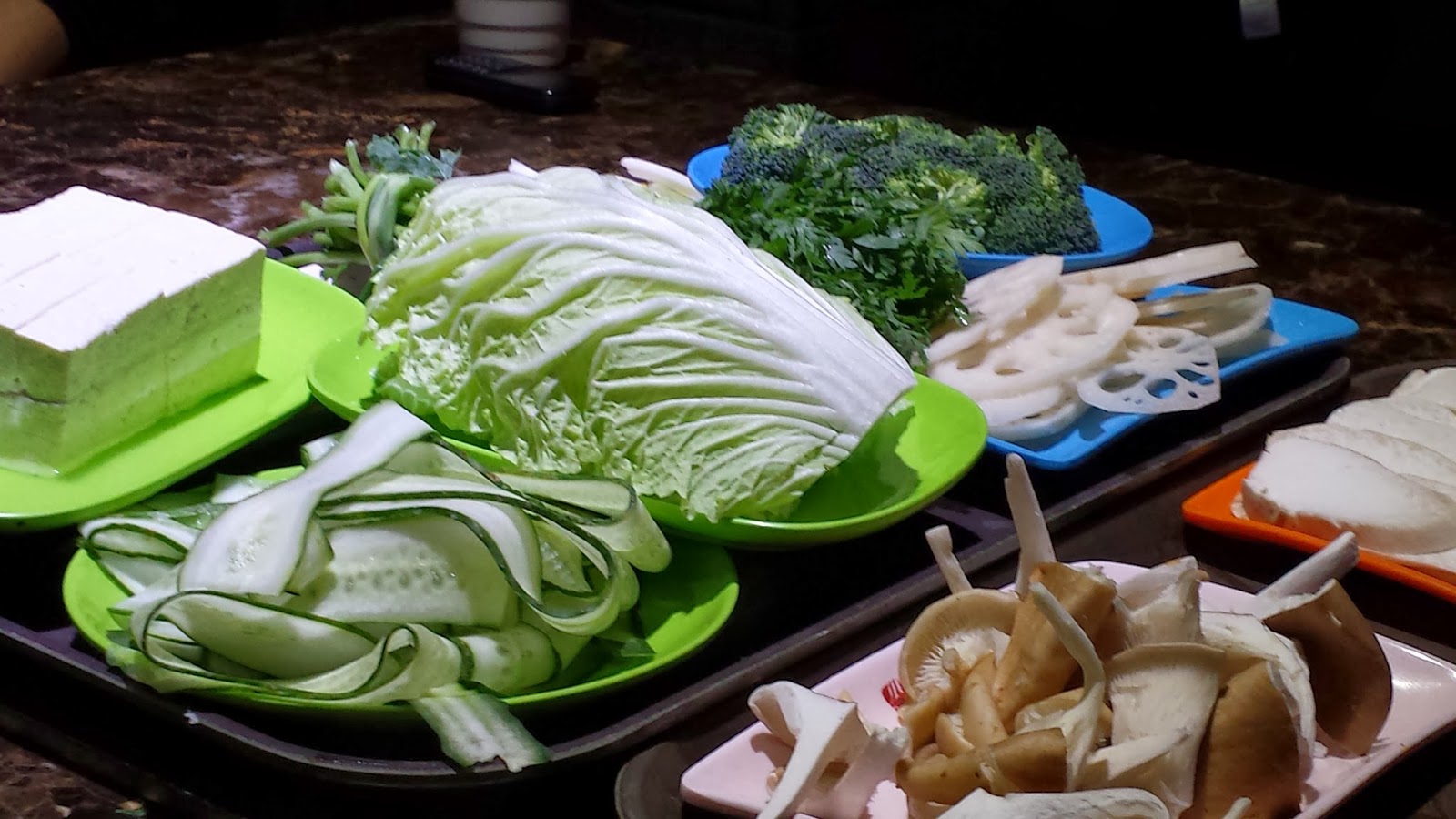
This hotpot is a lot more successful than our previous attempt in Beijing, where in a bizarre set of circumstances we ended up ordering what we wanted by speaking to the restaurant owner's nephew over the phone who spoke English. One of our friends almost ate raw tofu because we weren't sure how long things took to cook and fishing things out of the Hot Pot with chopsticks became a strategic nightmare (especially as anything dropped on the table must be left as it is considered 'dead'). In the end the waitress ended up plating up all of our food over an hour's meal. We couldn't even give her a tip because they don't do that in China.


This time, however, all goes well. Having had weeks to master chopsticks nothing is dropped, we can now gauge how long things must cook for and K has brought along her Chinese friends who order for us.

On the other hand this does mean that there are a lot of dishes I don't recognise. I politely point to one of the dishes that looks a little like a cross between a white stringy jellyfish and a mushroom and ask.

'Jeremy, what is this?'

He smiles. 'You know cow's have four stomachs? This is the first.'

'And that?' I point at something flat, brown and spiky, laid in strips on a plate.

'Fourth stomach of the cow.'

'And this?' I point at a white, spiky strip in resignation.

'Chicken stomach.'

'Jeremy, is there anything you have ordered that is not stomach?'

He thinks and then points over to a plate of kebab sticks with tiny lumps of dark red meat on them. 'This is not stomach.'

'Great,' I smile. 'What is it?'

'Chicken heart.'

I stick to the dumplings.

Outside the full moon is shining and we decide to finish the night in typically Chinese style.
 
We go to a karaoke bar, or as it's known in China, KTV.
 
Inside we pass rooms full of large groups of Chinese people singing very seriously. If we knew any Chinese we could have had a stab at singing the traditional songs.
 
Instead, we end up singing a lot of Abba very loudly and with die hard enthusiasm.
 
K's Chinese friends are understandably a little bemused by this and it is perhaps the strangest Autumn Festival celebration they have ever had- watching a group of English people sing Swedish songs very badly.
 
But it is a celebration none the less. Of birthdays, of festivals, of being in China and loving it.
 
And if there's one thing being in China has taught me, it's that you don't have to understand what's going on to have a good time.
 

Thursday, 7 November 2013

blood, sweat and stone

Leshan, Sichuan Province (14/09/2013)
Location: A 2 hour bus ride south from Chengdu.
Population: 533,000.
Famed For: Having the tallest Buddha in the world.


At the weekend we meet up with the other Chengdu interns in the city. It's a chance to catch up on what's been happening, swap gossip, trade teaching tales and relax, far away from anything that smells like chalk or students.

It also makes me and G feel incredibly lucky with our placement and school. I sit, fingers pressed to my mouth in horror at some of the stories the other interns share- apartments infested with mould, peculiar neighbours, demons guised as students who spit and sleep or swear and leave, forty hour weeks, lessons observed by parents and principals, inedible canteen food- and can say that the only unfortunate incident I've had so far is that on Friday morning I woke to find myself locked inside my bedroom.
 
(No amount of handle rattling, pulling, banging or coaxing would open the door. I had to yell for G -who was fortunately in the apartment at the time- who, to cut a long story short, called Beata, who sent a workman who  hummed and hawed and twisted the handle until he eventually agreed that yes, the door was indeed stuck shut.

At which point, he downed his bag of tools and kicked the door in.
 
Whatever works.)
 
The other interns are, of course, simultaneously both annoyed and impressed with mine and G's good luck, but we all toast to our experience here in China- we all know it'll be character building, character changing one way or another- and ganbei our beer.


It's an early start to a long day on Saturday as we journey to Leshan to see the giant Buddha carved into the mountainside.
It's the result of the ingenuity of an 8th century monk named Haitong; he hoped creating a giant Buddha to watch over the vast river that flowed past would calm the often turbulent and sometimes dangerous currents that threatened local shipping boats. This plan had a great deal of merit- the huge amount of rock and dirt shifted by carving out the giant Maitreya would be put in the river, altering the currents and slowing the river's flow.
 

Unfortunately, part way through, government funding for the project was threatened. Haitong, to show his piety and sincerity for the project decided to take drastic action.
 
 He gouged out his own eyes.   
 
We weave our way up through the pretty wooded park, round imposing stone towers, threading through crowds of worshippers at wooden temples, their knees bent on buttercup yellow cushions as they clutch smoking sticks of incense. The air becomes still, stifling, humming with insects. Our clothes cling to our bodies, sweat makes our skin shine, and my tongue cleaves to the roof of my mouth.
 
And then we emerge, breathless, beside the ear of Buddha.
 
Slightly mossy and a little faded with age, this 233ft statue is still breathtakingly impressive, and we follow the crowds of people lining up to carefully pick their way down the sharply cut stairs inlaid into the side of the mountain so that we can reach the bottom of the Buddha.

It's a slightly hairy descent, the steps often narrowed or worn with age, the handrail low and slippery and I'm glad I'm wearing sensible shoes and that I don't suffer from vertigo.


But it's worth the trip for the view at the bottom. The statue is so spectacularly large, that a family of three can quite easily have a picnic on the nail of the Buddha's big toe, and trying to angle the camera to take pictures of ourselves and the statue requires some imaginative placing. As it is, I manage to get a picture of myself and my friends K and L with a bit of the Buddha's leg in the background.
 

The rest of the weekend is spent recovering from the slog back up the mountainside and trying not the scratch at mosquito bites. We stroll through Jinli street, a pleasant tourist trap, full of shops selling prayer beads and jade, Tibetan carvings, good luck symbols engraved on grains of rice, indian scarves and sugar spun animals. We pick at food stalls selling everything from deep fried dumplings to something called 'three times mud', intestines to melon slices on sticks. It's a lovely place, especially at night when the glow of the red lanterns lights up the dark wood panelling that the shops are built from. Still, as we sit in Starbucks drinking hot chocolate, it's hard to believe that this is an authentic recreation of ancient China (which is what the sign proclaims as you enter the street.) It's the Disney version, clean and shiny and wholesome. 
 
We leave Jinli street with the feeling of having been in a kind of Twilight Zone, an Alice in Wonderland China, except here everything is horribly neat and orderly and disconcerting.
 
Five minutes down the road, someone clears their throat by my shoes and we almost get run over by a taxi.
 
Unconsciously, we all relax.


Tuesday, 29 October 2013

the post-it note justification


Jintang, Chengdu, Sichuan Province (09/09/2013)
Location: Arts and Sciences College of Sichuan Normal University
Population: 35,000 students


不闻不若闻之,闻之不若见之,见之不若知之,知之不若行之;学至于行之而止矣 不聞不若聞之,聞之不若見之,見之不若知之,知之不若行之;學至於行之而止矣

(Bù wén bù ruò wén zhī, wén zhī bù ruò jiàn zhī, jiàn zhī bù ruò zhīzhī, zhīzhī bù ruò xíng zhī; xué zhìyú xíng zhī ér zhǐ yǐ)

'Tell me and I’ll forget; show me and I may remember; involve me and I’ll understand'

Chinese Proverb
 
'Good Morning, Rachel!'
It is Monday morning and I have just been enthusiastically greeted by my first class of twenty second year university students as I walk through my classroom door. They are already seated in neat rows at the front of the room, paper out, pens at the ready, smiling and eager and ready to learn.
They are also twenty five minutes early to my lesson.
It could only be China. Teaching here is always an adventure. Sometimes it's frustrating and exhausting and you want to bang your head (or the students) against your desk just to get a response other than blank bemusement.

Sometimes you have to trick them into speaking because through a deadly combination of shyness, Chinese teaching methodology (students should be seen and not heard) and puzzlement at the mad Englishwoman gesticulating at the front of the classroom they are occasionally struck dumb. I put them in groups and sneakily sit next to them to hear them speak. I set True or False quizzes, making them stand up if they think it's false and sit down if they think it's true. Five questions in they're so sick of mimicking a jack in the box they're yelling the answers at me. Sneaky plan success.

Sometimes it's worrying. A lesson on family ends with us discussing the royal family and what the students would do if they were King or Queen for the day. Most of them help the poor, or go shopping or travelling. And then there's the student who stares in utter bafflement because they have genuinely no idea. There's also the student who grins and offers up the suggestion of 'killing the King and Queen because then I could do what I liked.'
It's difficult to know which is more terrifying- the pupil with the Machiavellian streak or the student with no imagination.

Most of the time though it's brilliant and hilarious and very easy to feel a great deal of affection for your students. One day, for example, teaching body parts and illness, we role play going to the doctor and I circle the class listening to them pretending to be ill. Then this genius bit of acting happens:
Boy One (clutching his stomach and groaning): Oh Doctor, I am very ill.
Boy Two (feeling his forehead): What's wrong?
Boy One: I am pregnant.
Boy Two (laughing): What? And who is the father?
Boy One: You are.
It's the moment when a student successfully uses the right words you've taught, then makes an imaginative leap and can make a joke in English that makes teaching worthwhile. Or seeing one student gently help another who is struggling to think of the right word. Or watching them pretend to give a news report, faces creased in concentration as they recall the correct vocabulary and intonation.

Mostly though I just enjoy watching them learn. 
 

There's a proverb in China that if you actively involve children in your lessons they'll learn and remember. So I make no apology for playing a lot of games with my students. Rock, paper, scissors. Pictionary. Charades. Twenty questions. Hangman. Anagrams. My students stick post-it notes on 'volunteers' (read: victims) to learn body parts. We watch and discuss film clips to illustrate points I've made in the lesson. Blackadder, Robin Hood, Man Vs Food. The more disgusting, funny or scary the better. We listen to songs to work out the lyrics: Rihanna's California Kingbed is good for doing body parts, Adam and the Ants' Stand and Deliver for crime, Madness' Our House for family, (though it's only as I'm watching that I wonder whether it's culturally appropriate for my class to be watching a man in drag play mother round a house).

My students are kind in unexpected ways. They leave me greetings on the blackboards. They set up the computer for me before I get to lesson, close curtains, find missing erasers, offer me their food, fill up my water bottle and take me into town to show me where to buy the best snacks. One of my students, Stephanie, makes it her personal mission to get my trousers turned up because 'Teacher, I am very concerned your pants are too long. We shall go and make them shorter.'

Our first weekend in Chengdu and unsure how to get back to the university, a student who speaks very little English buys bus tickets for me and G, shows us the correct bus, travels with us, then hails and pays for a taxi for us once we reach the local town afterwards. She flatly refuses any offer of reimbursement.
Being a teacher here is often funny and sometimes difficult and mostly amazing but always a privilege. Nothing will compare to that first moment, standing in front of twenty eager faces and opening my mouth and teaching. It felt odd and amazing and right. Like I'd always done it.

That first lesson, one of my students brings a note explaining their friend cannot come. I open the letter, expecting a few vague lines about illness and promises of future attendance.
Instead it begins:

'Dear Honorified Rachel...'
It could only be China.


Wednesday, 16 October 2013

the sichuan situation


Jintang, Chengdu, Sichuan Province (02/09/2013)

Location: A 28 hour train ride from Beijing to the very West of China.

Population: 12.5 million.

Famed For: Being the home of China's Pandas and the gateway to Tibet.


For twenty eight hours, China rolls past the train windows in a myriad of forms and colours. Leaving behind Beijing and the light rain that has begun to fall, the train speeds through the endless suburbs of towering apartment blocks, passing by shabby restaurants, pebble-dashed schools and lines of washing. The sky changes, becoming clear and sunny, then darker, clouds gathering at the corners like school children waiting for a fight. The landscape morphs into watered fields of rice and old men bent in half, picking the tender shoots. Tall bamboo sways in the wind and the mist begins to roll in as the ground starts to rise and fall becoming lush, green and mountainous, dotted here and there with ramshackle farm buildings and shabbily dressed locals, skin sun darkened and wrinkled.
 

Stepping off the train at Chengdu train station, the air wraps round us in greeting, hot and wet as though we've walked into the bathroom after someone else has showered. Sweat slicks our skin, shines our hair and presses our clothes close against our spines. Walking even short distances leaves the napes of our necks damp, faces flushed. The sky is missing, as though someone has reached up and painted it out in big, blank strokes of dirty white smog. Unlike cloud it has no texture, no shape, nothing to define the edges of it. It simply hangs, featureless and heavy over the city.

We are, however, an hour out of the city by car and as my flatmate G and I drive along the motorway in a taxi organised by our contact, Beata, the sky begins to reappear in patches of blue. We are living on campus at our placement at the Arts and Sciences College of Sichuan Normal University, and that turns out to be another pleasant surprise because the university is really rather impressive.


A large arched gateway manned by uniformed guards serves as the entrance. Beyond that is a tree lined avenue with a large bubbling fountain and rising behind it is the grand entrance building, made of light, skin coloured stone. A small lake with the glint of orange fish lies in the middle of the campus and everywhere is green and verdant and lovely. A black butterfly the size of a human hand flits over my head.


Our apartment is habitable enough, needing only a touch of TLC and some light cleaning. We are on the sixth floor though and there is no lift. No internet. No drinkable water. No air conditioning. No gas for our stove. We have only one key between us. Also, a colony of wasp-like insects inhabit the crack between the tiles and the window in our bathroom. Whilst they seem docile enough it does add a Fear Factor style element every time we need to use the shower or toilet.
I have decided I can never visit Australia.

Our neighbours, on the other-hand are lovely. On the floor below is Gregory, an American whose two great loves are coffee and guns. He's been here so long he knows all the tricks and tips and most importantly fixes our TV so that we have HBO movies, rather than just the ironically named Chinese state news channel - CCTV News - in English. He gives us hot chocolate and oatmeal cookies and speaks of a mythical shop called Metro, which stocks foreign foods including real cheese and Heinz baked beans. As proof of this he shows us his kitchen cupboards, containing an altar to the god of western foodstuffs- Coffee, Frosties, Pasta, Quaker Oats and Snickers.
 
Mark, who’s Dutch, smokes and who is generally tall and cool lives on the second floor with his Chinese girlfriend Elaine, (also a teacher and very excited about hotpot and teaching us to cook authentic Chinese food). After trying the canteen food, I too am very excited.
 
Finally there’s Joshua, a laid-back American, with dreadlocks, tattoos and his own rock band. He’s also the leader of our department.
 
They encourage us to tell Beata about the things that need fixing in our flat, especially the wasps. So we do.
 
Beata smiles blankly at us as if we are stupid for not realising that wasps are a design feature of every Chinese home. We explain we want them gone. She laughs at us.
 
'Aah, disgusting!' she giggles.
 
Friday morning there is a knock on the door. Outside is a tiny Chinese man who smiles, points at the paper in his hand, (which is all in mandarin) and then walks past me and into our bathroom. He flushes our toilet, grins and gives me a thumbs up. Then he leaves. The whole experience takes no more than a minute.
 
I am still not sure what has happened. I am, however, reassured that our toilet now has the approval of a stranger.
 
Beata comes to see us the next day. 'Is your toilet working now?'
 
'The toilet was always working,' I explain. 'It's the wasps that are the problem. Wasps.' I flap my arms and make the buzzing noise.
 
'Ah!' Beata nods. 'Wasps. I will sort this out for you.'
 
A week later the wasps are still here. On the upside, a man is now installing air-conditioning in my room.
 
I may have to work on my mime.

Monday, 7 October 2013

the city made of history


Beijing (29/08/13-01/09/13)

Population: 20.18 million.

Famed For: Being the Capital of China.


不到长城非好汉 (bú dào Chángchéng fēi hǎohàn)

'He who has never been to the Great Wall is not a true man.'

Chinese Proverb


The Great Wall of China is literally breath-taking. Undulating across the land, it dips and curves to follow the contours of the hills it sits on and in the morning light it emerges from the densely forested slopes like a great grey snake or the tail of a dragon, with it's ridged scaling turrets and winding pathways.

In some places the ascent becomes so steep and the steps so high and narrow that the handrail is the only thing left to cling onto. It stains the tourists' palms rust red and tests the muscles in your legs and the steel of your nerves. At some points the path becomes too constrictive to stop without blocking the way, so, with lungs heaving, you push onwards up towards the small fort that marks a stopping point.

But the view. Everything is worth it for the view.


It makes you feel...small.

Walking one of the new Wonders of the World, on steps which were two thousand years in the making, built by slaves and peasants and soldiers now long gone, for one of the world's oldest civilisations and here you are, one person casually standing on so much history.

The sense of perspective is both refreshing and terrifying. It's also coloured with a huge sense of achievement, because despite being one person you have in some way conquered the Wall, and followed in the footsteps of thousands of people before you.


You are now part of the history.

I stop to read some of the graffiti that has been scrawled along the Wall by previous travellers, hoping for some words of wisdom, some sense of profundity.

Eva + Carl woz here - '99

I can only assume they too were overwhelmed by the sense of history.


Meanwhile, in the heat of a cloudless blue sky day, the roof of the Forbidden City gleams gold and bronze and the sunlight picks out the small dragons that rest on the edges of the tiles. The white stone floors are impossibly bright against the sunburn-red walls and everywhere there is a sense of both grandeur and space. It's very different to a British Palace or a UK Stately Home, whose buildings are full of carpets and paintings, antiques and statues and so much clutter.
The Forbidden City exudes minimalism. The many Halls feature gleaming floors, a golden throne and perhaps a few vases as tall and wide as a grown man. The rest is space (the artefacts having mostly been moved to special museum rooms to the sides of the palace complex).
 
It means you have to use your imagination to travel back to 1420 A.D (when the Palace was finished) to imagine the smell of incense, food, the perfume of flowers thick in the air, servants running to and fro. The sound of courtiers trying to obtain favour, the echo of gongs, music from lutes, harps and drums. The Emperor seated on his throne, conducting affairs of state. The Empress sipping steaming fragrant tea. The concubines, secluded in their rooms, plotting their next political move.
 
Admittedly, this is quite difficult when half a dozen people try and take your photo at the same time.
 

To really gain a sense of just how big the Palace complex is (and to escape from the crowds) we took the short walk up to the top of Jingshan Park, directly opposite the Forbidden City. And once at the top the whole of Beijing unfurls like a large gilded flower opening at dawn, the hilltop providing a 360 degree view of the capital. The Forbidden City gleams and suddenly you can understand why they call the Palace a City because anything less would be ludicrous. It simply is that big.

Like the sprawling mass of the Great Wall, the Forbidden City seems larger than life, an impressive feat of planning, building and engineering. It's as though everything in Beijing is seen through a fairground hall of mirrors- everything is bigger, stranger and more exaggerated and it's been deliberately built like that. It almost seems like a type of madness, this obsession with size and grandeur.

But when you live in a country that contains one seventh of the world's total population, why do anything small?


Thursday, 12 September 2013

to race a tiger


Anything that walks, swims, crawls or flies with its back to heaven is edible

(Cantonese Proverb)


It is lunchtime.

In the markets the crowds are building and the air hangs thick with the smell of salt, oil, charcoal and meat. Hungry shoppers shoulder past each other on the look out for a bargain or their favourite snack, drawn in by price and colour and scent.


One stall sells seaweed wraps, another sweet pastries with kidney bean paste and sweetcorn stuffed in the centre. This one displays pale slices of melon, another chilli beef noodles, or pungent crab meat in dumplings. There are bowls of salted peanuts and bags of rice and spices.


But it is the shop down a covered alley and to the left where the crowds really are. Here there are young children and adults alike clamouring round and a shopkeeper who is kept busy handling customers.

For he sells starfish. Silkworms, brown and ribbed like tiny, misshaped cigars. Seahorse, stiff and glass eyed. Scorpions, three to a stick. They are still alive and wriggling.

And that tray of kebabs he has? Is it beef? Chicken? Mutton?


'Dog,' he confirms with a smile. 'Tastes good.'


Let me tell you a story.

Many, many centuries ago, the Jade Emperor, who rules from Heaven, decided that there should be a way to count the passing of the years. Sending out a proclamation across the lands he decreed that there would be a great race amongst all the beasts of the earth. The first twelve animals to cross through the vast forest and over the deep river would have a year named after them.
At dawn on the appointed day every creature assembled, and with the first rays of light the race began. Through a mixture of trickery and betrayal the rat won. He was followed by the kindly Ox, whom he had duped into carrying him across the broad river. The Tiger came next, dragging his powerful body from the water. Rabbit hopped after, having made his way over the water by rocks jutting from the river. The mighty Dragon was awarded fifth place, having stopped on his journey to bring rain to a drought riddled land. The Snake slithered from beneath the hooves of Horse to claim sixth place, forcing Horse backwards in fright and into seventh. Ram, Monkey and Rooster arrived together on a raft they had crafted. Dog appeared later, having stopped to wash himself in the river. Pig, having fallen asleep almost as soon as the race began was granted 12th place.

Thus the shengxiao or Chinese Zodiac was born and the years named and measured.

It's a lovely story from Chinese folklore. But that's all it is. A legend. A myth. As with all myths it concentrates on the symbols and misses the details.

Like the fact that the Chinese have a complicated relationship with their animals. Like the fact that of all the animals in the story the only one that is not considered as food is the Dragon, which is both sacred to the Chinese and imaginary. That the Chinese may name their years after their animals but that doesn't mean they aren't still tasty. That though many people in the country are Buddhist and therefore vegetarian, considering the balance of all life to be sacred, many other people will eat anything that moves and they will eat all parts of it. The brain. The heart. The eyes. That many will happily eat dog and have a pet chihuahua at home, because there is a difference between restaurant dog and pet dog.

At feeding time at Harbin Tiger Park they pay homage to their folklore, but instead of assembling all the beasts of the earth to the race they only have two competitors.

One hungry tiger. One live duck.

The legend talks of Tiger, who came third, all grace and strength and power. But it does not speak of the smell of Tiger. The unmistakable scent that hangs, hot and tangible in the air, like a musky blanket pressed against your face. The smell of power and anticipation. 

The legend of the Zodiac does not speak of Duck. Unmentioned, Duck is too slow to have a year named after him and loses to the other competitors.

The keepers release the animals into the pen and the assembled tourists crowd round, munching on their own lunch, cameras poised to capture the finish.

Some things in legend will always remain true.

In a race, Tiger will always win against Duck.


Thursday, 5 September 2013

the ghosts of Harbin


Harbin: 23rd August 2013

Where: North-East China, an 8 hour train ride from Beijing.

Population: 10 million

Famed For: The January Ice Festival


As I’m writing, someone has set off a box of firecrackers in the street opposite my hotel.

My friend, A, says they’re celebrating the birthday of someone important. A politician, or a god maybe. She’s not sure. They have too many. Here, there are gods and ghosts in everything. The kitchen, the sky, the grass… the past.

Yesterday, we passed people burning paper money in the streets to send to their ancestors.

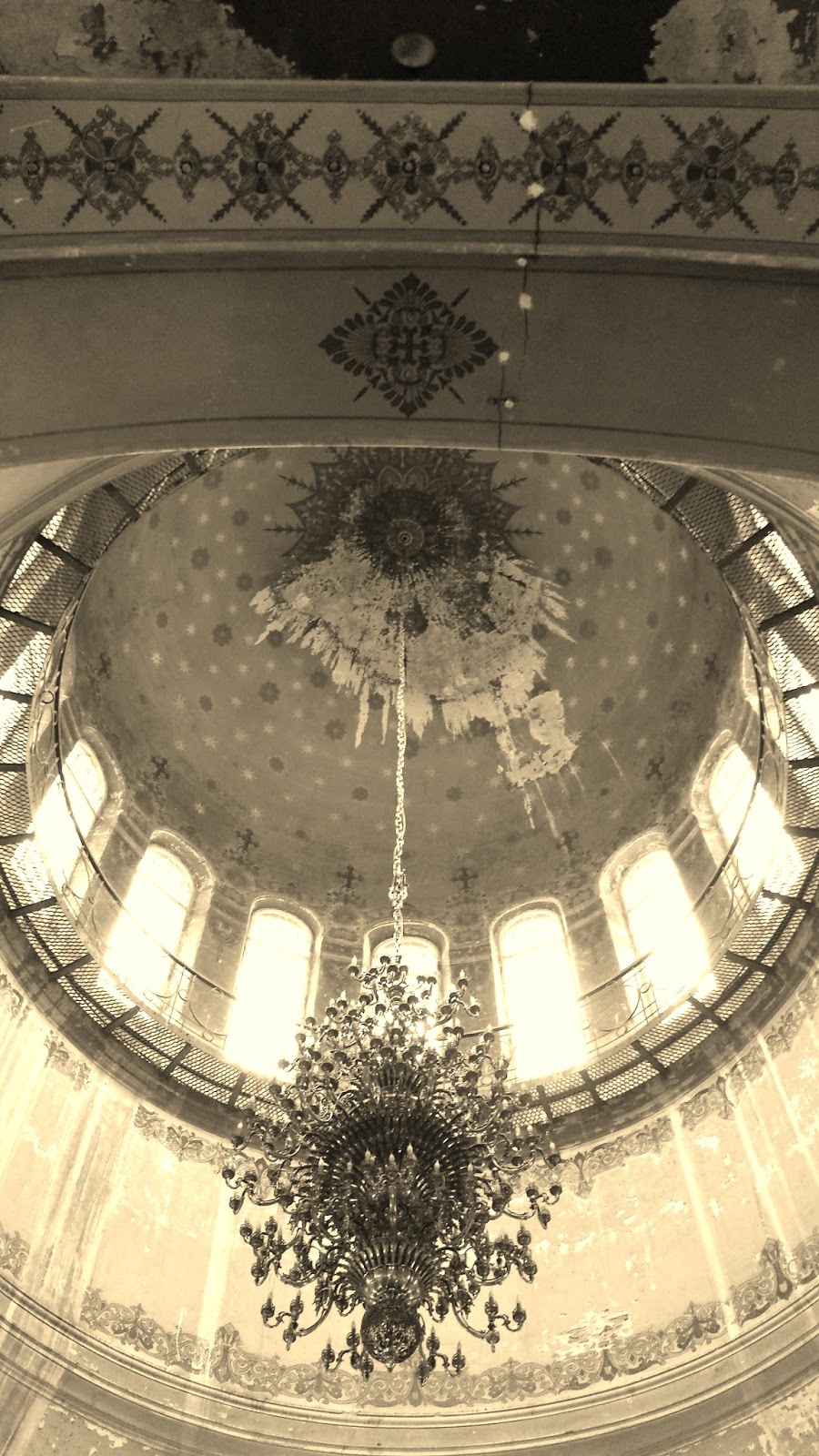
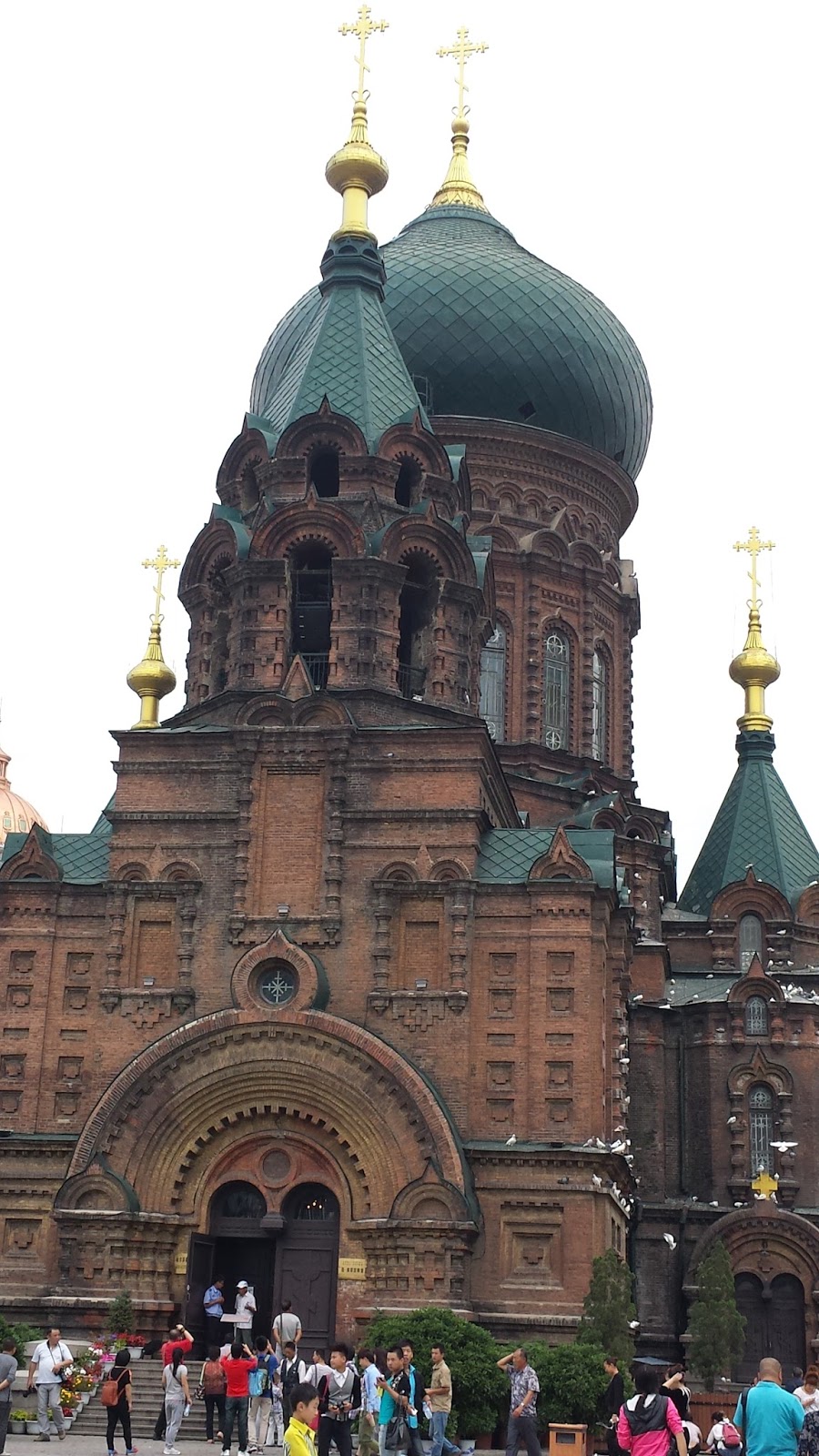
In the city centre, the century old byzantine church, St. Sophia, sits crumbling inside from decay. Chandeliers hang, unlit, from the domed ceiling. The wall murals are mostly gone and in some places the plaster is missing, baring the brickwork. It is beautiful and bleak and without religion. Instead it contains a photographic exhibition of China before ‘the liberation’. It’s a museum to the god of the state, to China and its people.

And Harbin, like its famous church, is shabby and yet somehow lovely.

In the morning daylight, the outskirts are rather worn looking. Blocks of flats stand half built against the skyline. Piles of brick and sand and tubing are heaped and left on the pavement. Telephone wires are impossibly knotted round an overcrowded pole and dangle down across the street. A few watermelons from a street vendor have dropped into the road and lie, exposing their glistening pink insides on the tarmac. The smell of roasting meat mixes with car fumes. A man with a mouthful of phlegm looks for a place to spit. In the background half a dozen taxis sound their horns. A scraggly looking kitten wanders into a hotel lobby and is hurriedly shooed out. Someone hangs their washing out to dry on a tree in the street.


The city centre, meanwhile, is spotlessly clean. The pedestrianized century old street with its cobbled road and tree lined pavements sports an odd assortment of Russian goods shops and western retailers. Costa sits comfortably next to a Babushka store. In H&M there is a sale. The vodka shop next door is conspicuously full. A street vendor selling squid tentacles and other unnamed meats has parked outside McDonalds. At the end of the street, a colonnade rings a statue to the flood defence system protecting Harbin from the grey river that flows through it.
It starts to gently rain.

Night-time is when Harbin looks its best, when the worn edges are hidden by the softness of the dark, and the sky glitters with the light of skyscrapers and KTV bars, street lamps and advertising billboards. It is still balmy in the evenings and we sit out on the pavements, drinking the local pijiu and pointing at pictures of things we think look recognisable on the menu. Balanced on plastic chairs we tuck into noodles, pork with potatoes, tofu and prawns in a spicy sauce and something so deep fried the meat is unidentifiable. White lotus root, carrots and bean sprouts are heaped onto enamel plates and platters of skewered meats are arranged around our table and in the evening light everything is electric and wonderful.

At the end of the meal, as we count out yuan, the waitress, giggling, hands over her iphone to another server so she can pose for a picture with us. A group of Chinese men on the next table say something in rapid Mandarin and suddenly they are all up, cameras out, posing for individual photographs with each of us.  

We are a strange novelty, us laowai, or less politely gweilos, which means white ghosts. Strangers stop to take our pictures, thrusting their bemused children into our arms. We pause to watch a fashion show on the high street and the photographers turn to snap us instead. At the Tiger Park we are more of an attraction for the visitors than the beautiful white Siberian cats we have come to see. People do it sneakily, pretending to take photos of buildings behind us. Or they do it brazenly and herd us together like sheep, before proudly posing in front of us.

We absently wonder what they do with the photographs as we hail a taxi home.
We’ve just had a long day of lesson planning and most of us didn’t get more than six hours sleep the night before, or the night before that, too busy talking to think of bed. Our exhaustion may explain why we are able to fall asleep despite the fact we are doing 120km/h down the main road, weaving in and out of the traffic, narrowly avoiding pedestrians and other drivers. None of us are wearing seatbelts because they are tied in a double knot against the windows. The lock is buried under the fake Chanel covered seats.
We wake briefly when our taxi makes a u-turn across six lanes of traffic to the soundtrack of car horns. Twenty minutes later and we pull up at the hotel, carefully counting out yuan in the neon light of Harbin at midnight.We stumble out of the taxi and into the hotel, silently crossing the floor to the lift. 
The hotel receptionist is asleep, her head pillowed on her arms as seven ghosts go by.

Outside, the firecrackers burn on.